
Most low back pain does not need surgery, laser or injections. In most cases it comes from inflammation of the muscles and ligaments around the spine, and the real treatment is simple instructions and exercises that strengthen the back muscles.
Medically reviewed by Dr. Mohamed Nawar, Consultant Neurosurgeon and Spine Surgeon — November 2026
If the pain continues or travels down your leg, send your MRI images and a description of your symptoms for the team to review.
Send your MRI via WhatsAppWhat are the most common causes of low back pain?
- Inflamed or weak muscles and ligaments. This is the most common cause. When the back muscles are weak, the load of any effort goes straight to the vertebrae. With heavy work, lifting or long periods of sitting, the muscles and ligaments become inflamed.
- Cold. Direct cold air, such as from an air conditioner, or moving from heat to cold, strains the back a lot.
- Inflammation of the back joints and the sacroiliac joint. The sacroiliac joint sits at the bottom of the spine, one on each side. When it is inflamed, it causes back pain that may spread to the leg, just like disc pain, so the two are often confused.
- A problem in the leg joints or in walking. Anything that makes your walk unbalanced loads the back unevenly. After months, low back pain appears, and it does not improve until the leg problem is treated first.
- Inflammation in many joints of the body. If the inflammation also affects the hands and other joints, an assessment by a rheumatologist is needed to look for an immune cause.
Is what the MRI shows the cause of the pain?
Not always. Much of what appears on an MRI is normal age-related change that has nothing to do with the pain:
- A disc bulge of one or two millimetres.
- Degenerative changes of the vertebrae.
- Mild narrowing of the spinal canal, 20–30%. Canal narrowing usually does not cause symptoms before it exceeds about 60–70%, and the percentage is always read together with the symptoms and the examination.
Treating low back pain: instructions and exercises
1. Instructions, to reduce the load on the inflamed area:
- Correct sitting: back supported, a small cushion behind the lower back, shoulders resting against the chair and neck relaxed.
- At a desk: do not bend over your work; bring it up to you while you stay supported.
- Lifting: use the correct way to lift things from the floor, and avoid heavy lifting while the inflammation lasts.
- Car seat: adjust it so your back is supported.
- Avoid long fixed positions: long standing and long sitting, and avoid cold and air conditioning.
- Warm compresses: a hot water bottle or heat pad for half an hour before sleep, then a 10-minute massage with the prescribed cream.
2. Exercises, to build the lower back muscles. When the muscles are strong, they carry the effort instead of the vertebrae, so the inflammation does not keep coming back.
- When to start: after the acute inflammation settles, about two weeks of rest, compresses and medication.
- Progression: start with easy exercises, increase gradually, and avoid any exercise that causes pain.
- Duration: continue the exercises at home for six months. Real improvement usually begins after 3–4 months, because building muscle takes time.
- Daily walking: at a brisk pace in an open space, once your knees are confirmed to be healthy. Start with five minutes a day, ten after a week, then increase gradually up to an hour a day.
- Where the exercises come from: we send the patient a video of the instructions and a video of the exercises.
Medication: only when needed. It may be taken regularly for the first two weeks, then as needed.
Do I need physiotherapy? Physiotherapy relaxes the muscles and eases the pain a little, but it is not the treatment. The real treatment is sticking to the instructions and exercises.
Do I need surgery, laser or injections? Not in these cases. If they are done, they will not help.
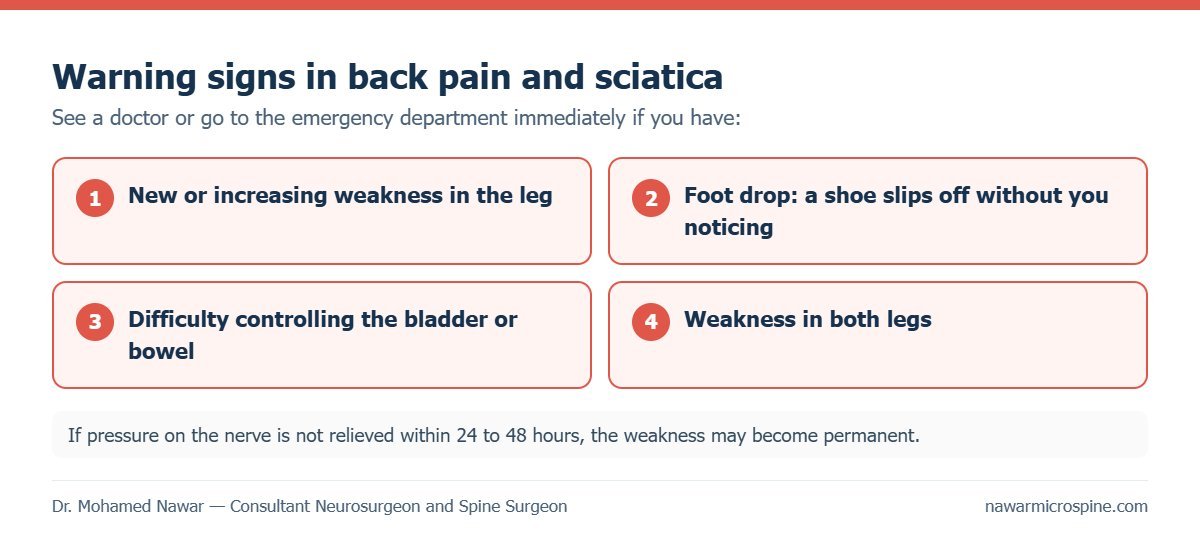
When is back pain a warning sign?
See a doctor immediately if you have:
- New or increasing weakness in the leg.
- Foot drop.
- Difficulty controlling the bladder or bowel.
If the pain travels down your leg, read about sciatica and lumbar disc herniation. If you have neck pain with hand numbness, read neck pain and hand numbness.
Share this graphic on your website
Copy the code into your page, keeping the source credit.
Watch Dr. Mohamed Nawar
Back pain from muscle inflammation and its treatment (Arabic) · Inflammation of the back joints and the sacroiliac joint (Arabic) · Spinal degeneration and sacroiliac joint inflammation (Arabic)
Frequently asked questions about low back pain
My MRI says “mild disc herniation”. Do I need surgery? Usually not. A mild bulge is normal with age, and most back pain comes from muscles and ligaments.
When will I feel better with exercises? Usually after 3–4 months of commitment, and the exercises continue for 6 months.
Do warm compresses help? Yes: half an hour before sleep, followed by a 10-minute massage.
Is air conditioning bad for my back? Direct cold air is one of the things that strain the back most, so avoid it.
What should I send for a review?
Tell the team when the pain started, whether it travels down the leg, any weakness or numbness, and the treatments you have tried. Include your MRI images and report if available. Send your case details via WhatsApp · Information for international patients